Inquiry Considerations for Heat Dissipation and Operating Environment of Hydraulic Pump Stations
When purchasing or configuring a hydraulic system, the thermal balance performance and operating environment adaptability of the hydraulic pump station are directly related to the continuous operation stability and service life of the equipment. Excessive oil temperature will lead to a decrease in hydraulic oil viscosity, accelerated aging of seals, and increased internal leakage of pumps and valves. Therefore, before initiating an inquiry with a supplier, clarifying the on-site working environment and heat dissipation requirements is a key prerequisite for model selection and calculation.
Communication Points for Ambient Temperature and Space Conditions
The on-site operating environment is an important basis for determining the structural design of a hydraulic power unit. Before making an inquiry, the buyer should thoroughly summarize the ambient temperature range of the installation site, especially the maximum summer temperature and minimum winter temperature. For pump stations installed indoors, it is necessary to evaluate the ventilation status and effective heat dissipation area of the installation space to avoid abnormal temperature rise caused by local heat accumulation; for outdoor or special operating conditions, it is necessary to explain to the manufacturer whether there are factors such as dust, moisture, salt spray, or corrosive gases. Specific protection levels and anti-corrosion requirements need to be confirmed with the supplier based on actual site conditions.
Evaluation of Heat Dissipation Selection and Duty Cycle
The heat dissipation solution should be calculated according to system losses, environmental conditions, and operating duty cycles. During the inquiry, explain the action cycle, continuous operating time, and load changes, and provide equipment information for the supplier to calculate heat generation. For air cooling, it is necessary to confirm the inlet air temperature, ventilation conditions, and cleaning/maintenance space; for water cooling, it is necessary to confirm the cooling water temperature, flow rate, water quality, and on-site water supply conditions. The cooling method should not be decided solely by the size of the pump station, nor should it be assumed that adding an independent circulation loop will necessarily solve heat dissipation issues under high ambient temperatures. Require the supplier to explain the applicable conditions of the scheme and the basis for oil temperature control.
Inquiry Preparation and Technical Docking Checklist
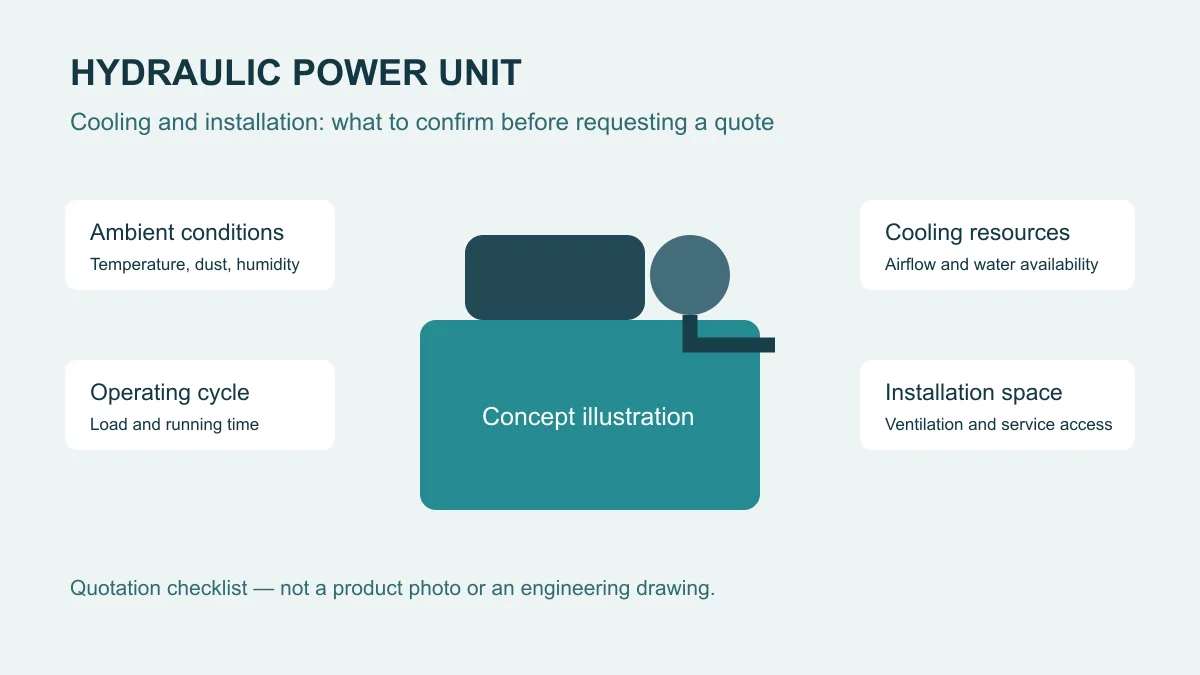
To improve inquiry and selection efficiency, the procurement department is advised to summarize and verify the following operating parameters before contacting suppliers: – Maximum and minimum ambient temperatures at the site, as well as indoor or outdoor installation locations. – Availability of cooling water resources, including water temperature, pressure, and quality. – Duty cycle of the pump station, such as continuous operating hours, a single work cycle, and shutdown intervals. – On-site installation space size limits and ventilation conditions. – Medium oil type and target operating oil temperature range. – Whether there are special explosion-proof, dust-proof, or low-noise requirements.
Summary and Procurement Recommendations
Accurate heat dissipation evaluation can effectively reduce later operational failures and maintenance costs of the equipment. Since heat generation and heat dissipation coefficients vary under different operating conditions, specific radiator heat exchange areas, oil tank capacity designs, and piping selections should be professionally calculated and confirmed by the supplier after detailed operating condition data is provided. Fully communicating environmental parameters prior to procurement lays a solid foundation for the subsequent smooth installation and stable operation of the equipment.
The accompanying image is a conceptual diagram created for this article, intended to organize inquiry key points such as environmental conditions, operating cycles, cooling resources, and installation space. It is not an actual product photo, engineering drawing, or delivery case of our company. Actual structures, dimensions, and cooling configurations are subject to technical data confirmed by the supplier.
Prepare an enquiry