Hydraulic Power Unit Selection Parameter Guide: Technical Data to Confirm Before Procurement and Inquiry
In industrial automation and mechanical equipment matching, hydraulic power units serve as core devices providing hydraulic power, and their selection accuracy directly affects the operating efficiency, energy consumption, and service life of the entire equipment. Before initiating an inquiry or submitting procurement requirements to suppliers, technical and procurement personnel need to conduct a comprehensive evaluation of the actual working conditions of the equipment. Preparing adequate technical data not only shortens technical communication time but also effectively avoids equipment mismatch or later modification costs caused by parameter deviations.
Core Hydraulic Parameter Organization and Confirmation
When evaluating selection requirements, first clarify the motion execution requirements of the hydraulic system. This mainly includes the maximum working pressure, rated working pressure, and flow requirements for continuous or intermittent operation. Designers need to calculate the actual oil supply required on site based on the quantity, moving speed, and output thrust or torque of actuators (such as hydraulic cylinders or hydraulic motors). In addition, the type of working medium (such as standard anti-wear hydraulic oil, water-glycol fire-resistant hydraulic oil, etc.) and the target operating oil temperature range are also important bases for selecting pump body materials and seal specifications.
Electrical Configuration and Control Logic Requirements
In addition to the hydraulic circuit itself, matching the drive source with the control unit is equally critical. Before procurement, verify on-site power supply conditions, including voltage level, frequency, and whether an explosion-proof motor is required. Regarding control methods, clarify whether to use manual directional valves, solenoid directional valves, or electro-hydraulic proportional control systems, and whether an integrated PLC control cabinet or reserved signal interfaces are needed. For projects requiring automation integration, input/output signal types and communication protocols of the control system should also be confirmed with the supplier in advance.
Installation Space and Environmental Condition Constraints
The installation space and external operating environment of hydraulic equipment have a decisive influence on the system structural design. Before purchasing, measure and provide on-site installation dimensional limits for the power unit, including external dimensions, oil tank capacity requirements, and access passages needed for maintenance. At the same time, operating conditions such as ambient temperature, humidity, dust concentration, and the presence of corrosive gases will affect the selection direction of oil tank materials, heat dissipation methods (air cooling or water cooling), and electrical protection levels. If operating conditions are special, specific technical standards must be discussed in depth with the supplier during the actual inquiry process.
Data Checklist Prior to Procurement Inquiry
To facilitate efficient technical communication with suppliers, it is recommended to complete the organization and verification of the following data before issuing an inquiry letter: – Actuator parameters: Quantity, bore size, stroke, and operating cycle timing of hydraulic cylinders or hydraulic motors. – Pressure and flow requirements: Maximum working pressure, rated flow, and duty cycle (continuous or intermittent) of the system. – Power and electrical specifications: Main motor power, power supply voltage, starting method, and explosion-proof level requirements. – Control and valve manifold configuration: Valve block integration method, control voltage (such as DC24V or AC220V), and interface types. – Environmental and heat dissipation conditions: On-site ambient temperature range, availability of cooling water source, and cooling preferences. – Structural and installation requirements: Estimated oil tank capacity, overall dimension limits, and port connection forms.
After collecting the above information, it is recommended to organize the requirements into a written technical specification and submit it to the supplier. Since selection details vary significantly under different operating conditions, specific system configuration plans, product material selections, and final prices and delivery times must be confirmed with the supplier based on the actual inquiry status.
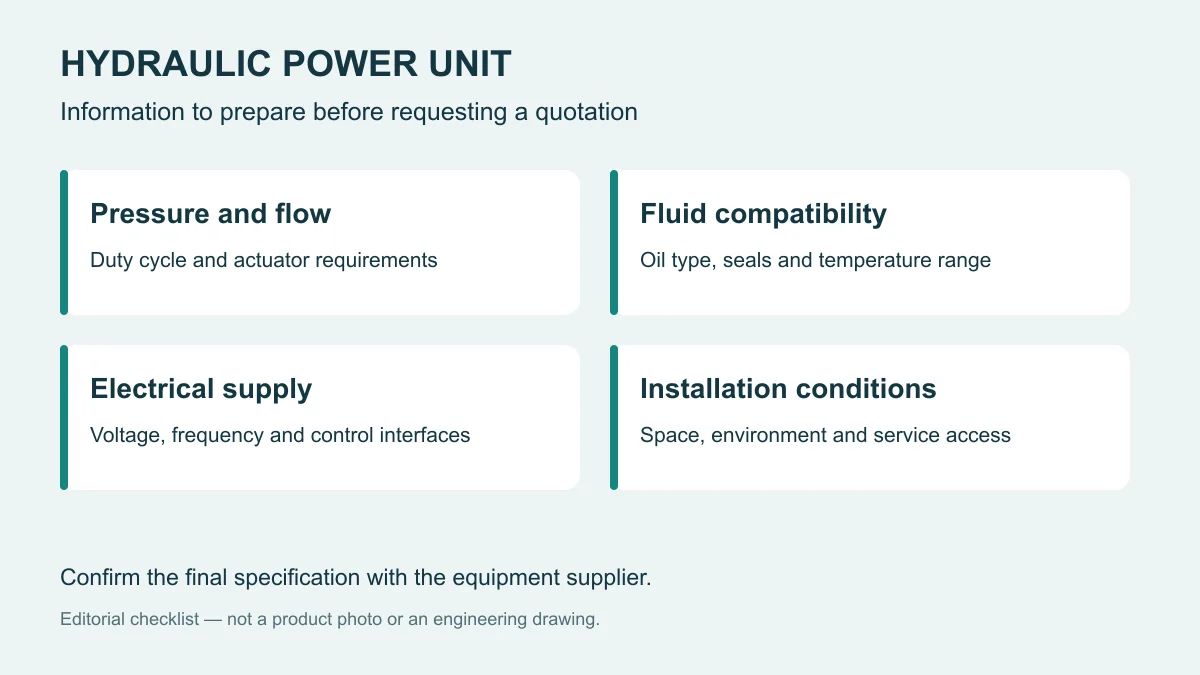
The attached image is an infographic of the procurement data checklist produced for this article, summarizing pressure and flow, medium compatibility, power control, and installation conditions; it is not a photo of an actual product or an engineering drawing. The final selection and configuration must be calculated and confirmed by the equipment supplier based on actual operating conditions.
Prepare an enquiry